30.9 GB as one zip, every file checked in this tab
Choose where to download from. Every file is checked against its address as it arrives.
Status
Verified
Base model
…
Lineage
…
Unchanged from base
…
Trending
#20
Downloads, 30 days
128k
Weights
30.9 GB
Revision
ZONOS3-Mini is Zyphra’s compact, open-source text-to-speech model, delivering natural reliable speech and high-fidelity voice cloning with just 100 million active parameters. It runs in real time on phones and laptops, including directly in the browser.
Through the hub: the same tools, each file from a source that is up (Hugging Face, ModelScope, IPFS), at this revision. The last line checks every file against the hash the tree names.
ZONOS3-Mini is Zyphra’s compact, open-source text-to-speech model, delivering natural reliable speech and high-fidelity voice
cloning with just 100 million active parameters. It runs in real time on phones and laptops, including directly in the browser.
Clone a voice from an audio sample, or design a character by shaping age, accent and vocal texture. Steer emotion, pace and
delivery down to individual words for games, narration and voice assistants.
Run ZONOS3-Mini locally with our browser and native runtimes, or access it through Zyphra Cloud. Model weights are released
under Apache 2.0.
Model details, samples and evaluations are in the blog post.A hosted version is available at Zyphra Cloud.
ZONOS3-Mini runs entirely on your own GPU through WebGPU: no install and no server. The first visit downloads the model, and
the browser keeps it cached for later visits. You need a browser with WebGPU support.
Lite: quick voice cloning. Pick, upload or record a voice and
speak with it.
With SGLang
SGLang-Omni serves ZONOS3-Mini on NVIDIA GPUs behind the OpenAI-compatible
/v1/audio/speech endpoint, with streaming and voice cloning from a reference clip (no transcript needed). Install SGLang-Omni
by following its installation guide,
then start a server:
Once curl http://localhost:8000/health reports "healthy", generate speech with the default voice from another terminal:
curl -X POST http://localhost:8000/v1/audio/speech \
  -H "Content-Type: application/json" \
  -d '{"input": "Hello from ZONOS3-Mini!"}' \
  --output output.wav
Add "references": [{"audio_path": ""}] to clone a voice, or "stream": true, "response_format": "pcm" to
stream 44.1 kHz audio as it is generated. The ZONOS3 cookbook
covers voice cloning, streaming and the sampling options.
Native runtimes
The ZONOS3-Mini GitHub repository holds Zyphra's own runtimes, which share one HTTP
API and serve the Zonos Voice Studio: a CUDA server for NVIDIA GPUs, an MLX server for Apple Silicon, a C++/ggml server and CLI
(CPU, CUDA, Metal or Vulkan), and the in-browser WebGPU build.
They load the GGUF files in gguf/ and the WebGPU shards in
web/; the 27 default voices, grouped by language, are in
gguf/voices/.
Architecture (rough outline)
Text is NeMo-normalized (English, Mandarin, Japanese, Korean, German, Spanish, French, Italian, Portuguese; other languages
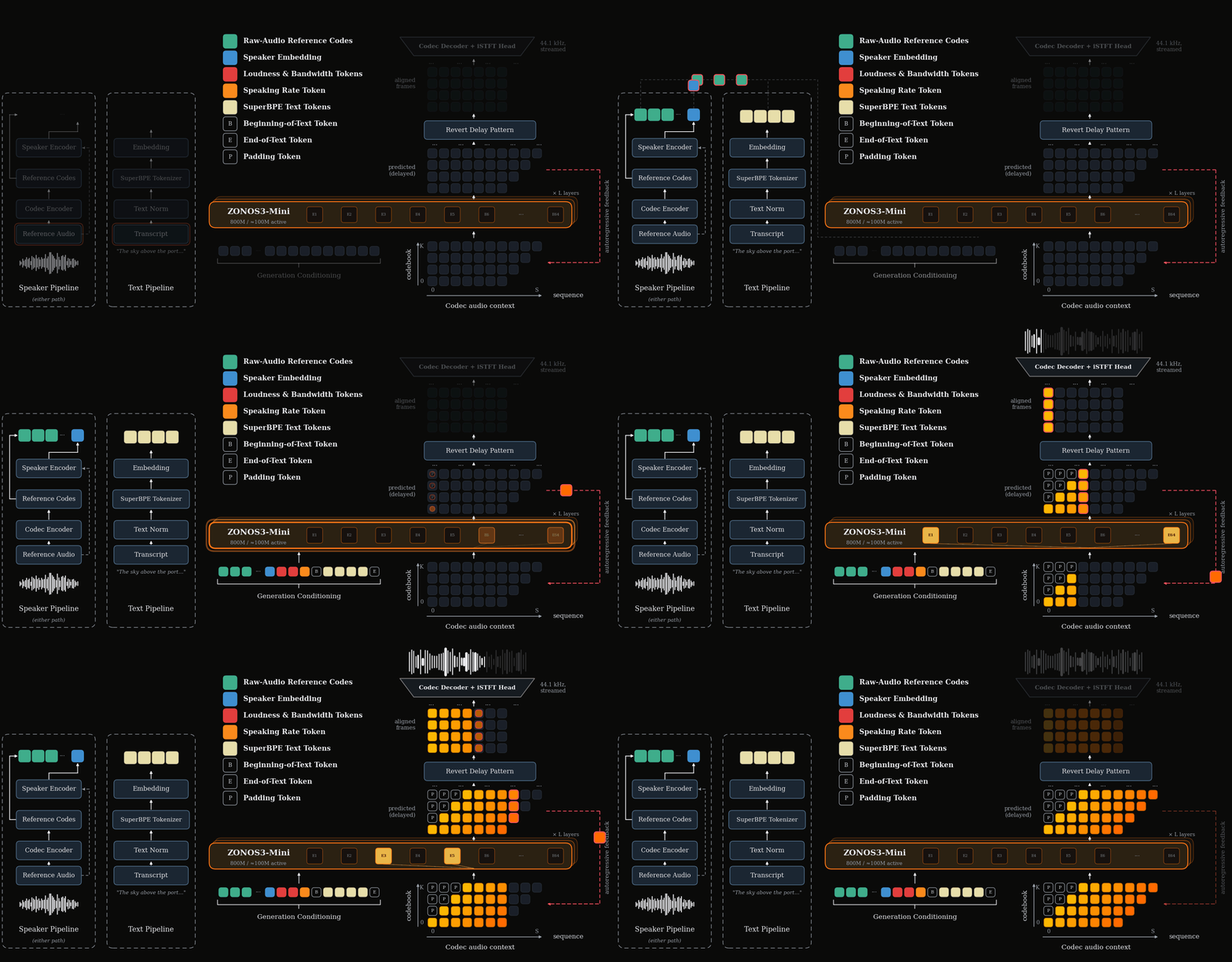
pass through as written) and encoded with an 8,192-entry SuperBPE tokenizer. The language model autoregressively generates 15 Hz
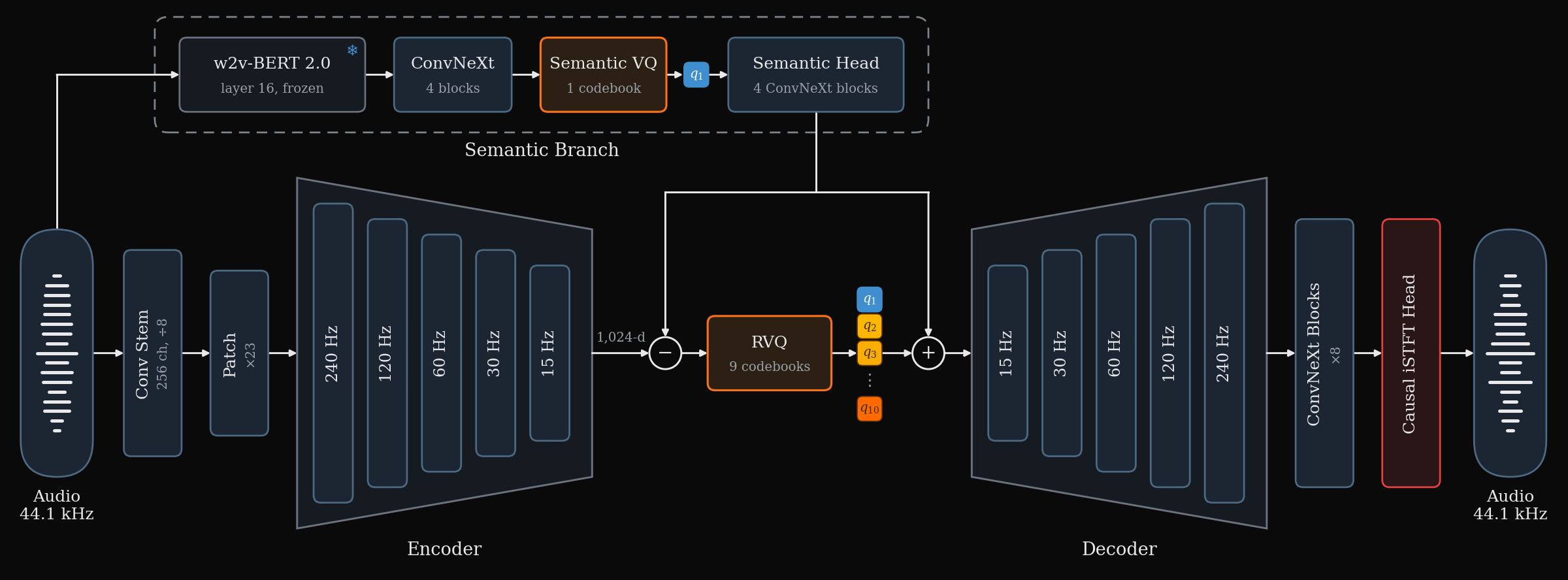
dual-codec frames (10 codebooks of 4,096 entries each: one semantic codebook distilled from the Wav2Vec2-BERT teacher plus nine
acoustic codebooks), conditioned on the text, a speaker prompt and three bucketed acoustic controls. A causal multi-resolution
iSTFT head renders the frames to 44.1 kHz audio as they are produced.
Inference pipeline. Speaker conditioning (raw reference codes or a speaker-embedding row), control rows and SuperBPE text enter
the hybrid GDN/attention MoE backbone, which predicts all ten codebooks of the next frame under the delay pattern (four drawn);
as soon as a frame's last codebook is generated, the codec's causal iSTFT head renders that frame to audio.
ZONOS3-Mini
Backbone
11 layers, model dim 1,024; 800M parameters total, about 100M active per token (latent MoE: 64 experts, top-2 routing, from layer 1)
SuperBPE, 8,192 entries (+4 specials), NeMo text normalization at inference
Audio tokens
15 Hz, 44.1 kHz dual-encoding codec, 10 x 4,096 codebooks (1 semantic + 9 acoustic); hop 2,940 samples; up to 10 minutes of audio per generation
Speaker prompt
raw reference clip (encoded by the codec into a token prefix, up to 60 s, with speaker CFG) or a single 192-d MECT-B2 speaker embedding (ownmect_s2)
Controls
loudness (LUFS, 10 buckets), bandwidth f_max (Hz, 10 buckets), speaking rate (UTF-8 bytes per second, 30 buckets); each row has an "unknown" index; bucket edges in params.json (condition_edges)
Decoder
causal multi-resolution iSTFT head: full_mr (default) or keep2_plain (pruned, about 3x faster decode)
Precision
bf16 weights (model.pth); decoder heads run in fp32
ZAC 1 (Zyphra Audio Codec 1).
Evaluations
Full results and the ZTTS2 capability index are in the blog post.
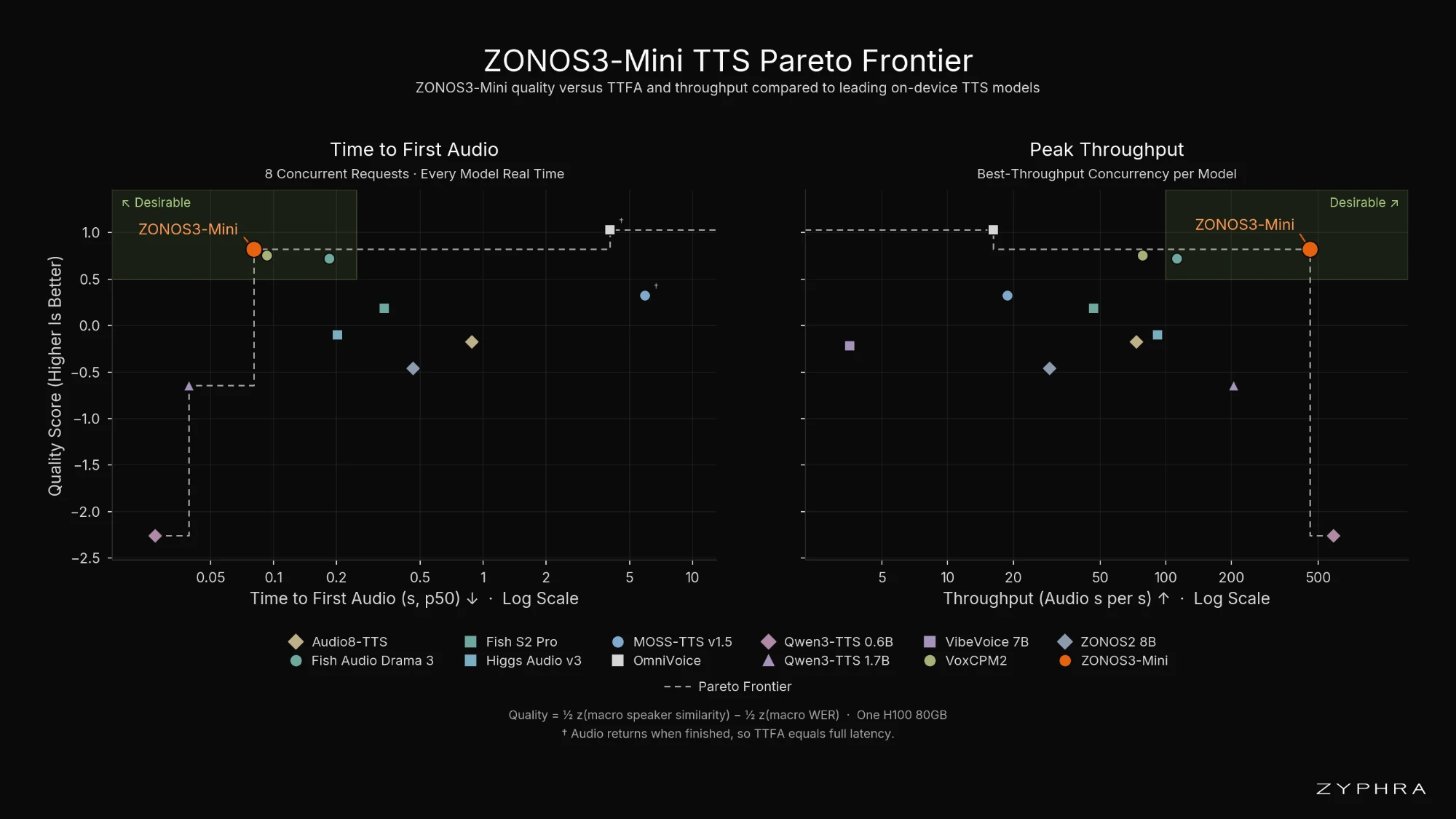
Quality against speed on one H100 80GB. Quality combines macro speaker similarity and macro WER over the 55 language subsets of
ZTTS2-Eval (benchmark version 2: FLEURS-R read speech in 35 languages and VoxBlink2 in-the-wild recordings in 20 languages) as
½ z(similarity) − ½ z(WER) across the systems shown; ZONOS3-Mini is measured with the speaker-embedding prompt. Left: median
time to first audio with 8 concurrent requests (80 ms for ZONOS3-Mini). Right: peak throughput at each model's best concurrency
(457 seconds of audio per second for ZONOS3-Mini).
Citation
If you find this model useful in an academic context, please cite the technical report:
@misc{zyphra2026zonos3mini,
  title         = {{ZONOS3-Mini Technical Report}},
  author        = {Gabriel Clark and Sofian Mejjoute and George Close and Beren Millidge},
  year          = {2026},
  eprint        = {2611.16525},
  archivePrefix = {arXiv},
  primaryClass  = {cs.SD},
  url           = {https://arxiv.org/abs/2611.16525},
}
Derived on Nov 18, 2026 from Hugging Face at revision 2921b882, README.md .
342 files, 30.9 GB. Every download is checked against its address.