

- Status
- Verified
- Base model
- …
- Lineage
- …
- Unchanged from base
- …
- Trending
- #21
- Downloads, 30 days
- 1.7k
- Weights
- 73.6 GB
- Revision
Maxwell-V1.0-Flash is a next-generation, high-performance Mixture-of-Experts (MoE) language model developed by the Maxwell Team, with 35B total parameters and 3B active parameters per token (both excluding embeddings) and support for context lengths up to 256K tokens.
At a glance
- Task
- Text generation
- Input
- text
- Output
- text
- Parameters
- 36.8B, 256 experts, 12 active
- Architecture
- Maxwell MoE
- Context
- 512K tokens
- Precision
- BF16 100%
- Format
- Safetensors
- License
- Apache 2.0Commercial use
- Released
- Oct 2026
- Updated
- Nov 2026
- Likes
- 107
- Downloads, all time
- 287
Architecture
- Layers
- 45
- Hidden size
- 2,048
- Attention
- 32 heads, grouped query, 4 KV heads
- Experts
- 256 total, 12 active per token
- Vocabulary
- 200,704
- Positions
- 524,288
- RoPE theta
- 20,000,000
- Tied embeddings
- No
Family
Models built on Maxwell-V1-Flash.
Run it
Pinned to the indexed revision.
hf download maxwell-model/Maxwell-V1-Flash --revision ca536c4380e0600d6aebdb808d2ce65ec724161bThrough the hub: the same tools, each file from a source that is up (Hugging Face, ModelScope, IPFS), at this revision. The last line checks every file against the hash the tree names.
export HF_ENDPOINT=https://gethologram.ai
hf download maxwell-model/Maxwell-V1-Flash --quiet && hf cache verify maxwell-model/Maxwell-V1-Flash
Spaces
Used in 1 Spaces.
Read the full model card

[](https://maxwell-llm.ai/)
[](https://maxwell-llm.ai/playground)
[](https://huggingface.co/maxwell-model/Maxwell-V1-Flash)
[](#6-license)
📄 [Technical Report](https://github.com/maxwell-model/Maxwell-V1-Flash/blob/main/Maxwell_v1_flash_tech_report.pdf) |
💬 [GitHub](https://github.com/maxwell-model/Maxwell-V1-Flash)
1. Model Introduction
Maxwell-V1.0-Flash is a next-generation, high-performance Mixture-of-Experts (MoE) language model developed by the Maxwell Team, with 35B total parameters and 3B active parameters per token (both excluding embeddings) and support for context lengths up to 256K tokens. It is designed for strong reasoning, agentic, and long-context capabilities at a practical inference cost.
Key Features
-
Maxwell Block Sparse Attention (MBSA). Each KV group keeps fixed coverage of 8 prefix and 8 local 128-token blocks and adds up to 16 remote blocks chosen by a learned indexer, bounding main attention at 4,096 tokens per KV group while the full-history KV cache stays available. The MBSA kernel is 6.7x faster than dense GQA at 256K.
-
Manifold-Constrained Hyper-Connections. Multiple residual streams with learned, input-dependent aggregation and constrained mixing, widening information flow without extra attention or feed-forward evaluations.
-
Fine-Grained Mixture of Experts. A mostly-MoE backbone pairing fine-grained routed experts with always-active shared experts, using a dynamic routing correction bias alongside a lightweight sequence-wise load-balancing loss.
Pre-training. Approximately 26T tokens of multilingual data, with the Muon optimizer on most hidden weight matrices. Training starts dense; block-sparse attention enters at 128K mid-training, once the indexer is warmed up against dense full-history attention, then trains jointly with the backbone.
Tokenizer and Long Context. A script-aware multilingual tokenizer stays compact across languages, especially low-resource Southeast Asian ones such as Thai, Lao, Myanmar, Khmer, and Shan. Long-context training then extends the sequence length in stages from 4K to 256K.
Post-training. Two-stage all-domain SFT builds general, reasoning, and agentic capabilities, then targets harder reasoning problems and agent trajectories. Independent RL branches cover general tasks, verifiable reasoning (mathematics, science, logic, code), and agentic tasks (search, terminal use, function calling, software engineering). Multi-teacher on-policy distillation then merges them into one model by supervising student-generated responses.
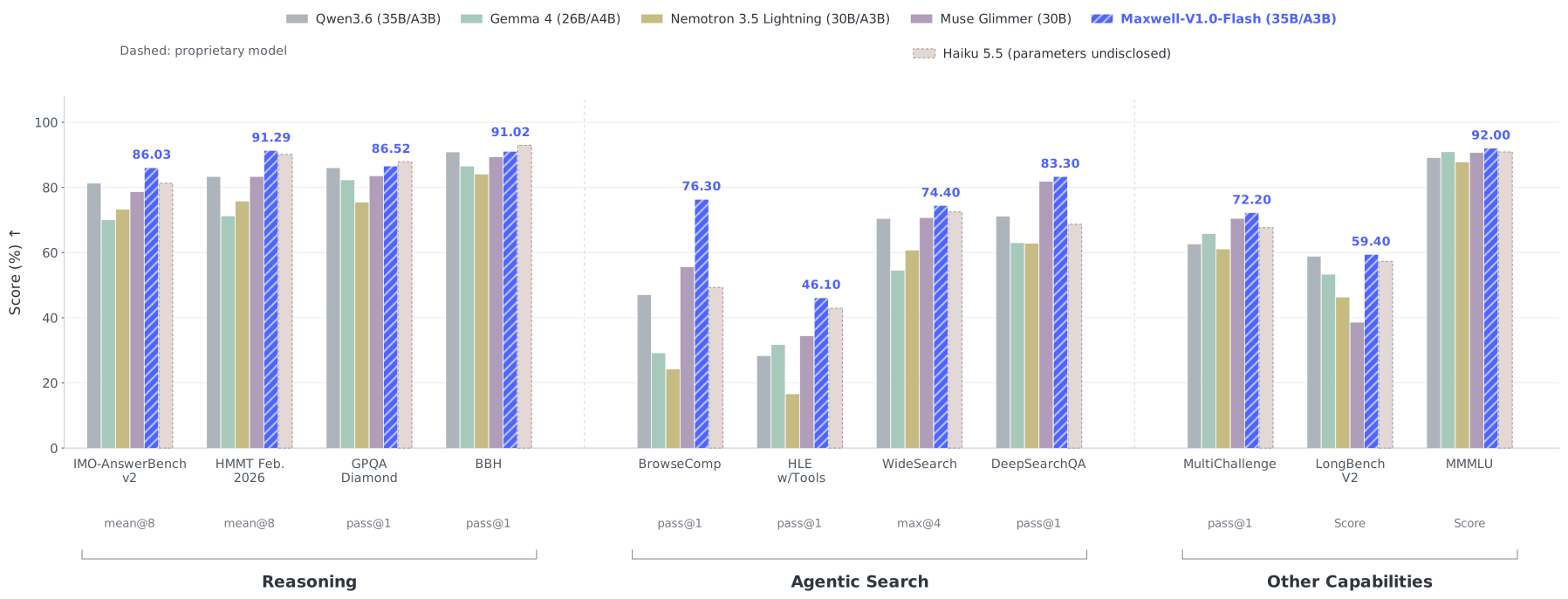
The results below summarize Maxwell-V1.0-Flash's performance across reasoning, agentic search, and other capabilities alongside the evaluated comparison models.

2. Model Specifications
  Component
  Configuration
  Value


  Model
  Architecture
  Mixture-of-Experts (MoE)


  Model type
  Text-only causal language model


  Total / active parameters
  35B / 3B


  Tokenizer
  Vocabulary size
  200,704


  Backbone
  Transformer layers
  45


  Hidden size
  2,048


  Configured sequence length
  262,144


  Attention
  Query heads / KV heads
  32 / 4


  Head dimension
  128


  RoPE base
  10,000,000


  Dense-GQA query-position prefix
  16K tokens


  Attention beyond the dense prefix
  BSA


  Block size
  128 tokens


  Maximum block budget per KV group
  32


  Prefix / local / remote block budgets
  8 / 8 / 16


  Indexer
  Query heads / key heads
  4 / 1


  Head dimension
  128


  Dense FFN
  Layers
  3


  Intermediate size
  6,144


  MoE
  Layers
  42


  Routed experts (total / active per token)
  256 / 12


  Shared experts per layer
  2


  Intermediate size per expert
  512


  mHC
  Residual streams
  4


  Sinkhorn–Knopp iterations
  20


  Initial scale of input-dependent mappings
  0.01


  MTP
  Auxiliary layers
  1


  Attention type
  Dense GQA
The block budget applies in sparse-attention mode. The MTP layer is auxiliary and is not included in the backbone layer count.
3. Evaluation Results
Base model. Maxwell-V1.0-Flash (Base) is compared with two Qwen base models of comparable scale under a unified internal evaluation framework. All scores are percentages; the best score in each row is shown in bold. GSM8K is evaluated using pass@8.
  Category
  Benchmark
  Qwen3.0-w30a3-base
  Qwen3.5-w35a3-base
  Maxwell-V1.0-Flash (Base)


  Math
  GSM8K (pass@8)
  97.95
  98.41
  97.19


  MATH-500
  59.00
  57.50
  71.40


  MinervaMath (MATH)
  62.14
  58.62
  74.56


  MathQA
  60.40
  63.69
  66.10


  Code
  HumanEval
  70.73
  67.68
  78.05


  MBPP
  73.93
  61.09
  65.37


  HumanEval+
  63.41
  56.10
  71.95


  MBPP+
  75.40
  70.90
  75.13


  STEM
  MMLU
  80.98
  82.85
  79.85


  MMLU-Redux
  78.17
  78.17
  74.90


  MMLU-Pro
  61.64
  64.68
  65.25


  ARC-Easy
  80.01
  82.15
  86.78


  ARC-Challenge
  57.59
  62.12
  65.78


  BBH
  28.08
  52.17
  57.01


  GPQA-main
  40.62
  54.69
  52.68


  GPQA-diamond
  42.42
  54.04
  51.52


  Multilingual
  MMLU (SEA)
  73.89
  77.37
  75.06


  XCOPA (SEA)
  79.63
  78.93
  79.80


  OpenBookQA (SEA)
  43.20
  41.30
  43.30


  ARC-Challenge (SEA)
  51.83
  54.67
  58.13


  MGSM
  85.20
  84.13
  83.87


  Knowledge
  HellaSwag
  81.38
  83.64
  79.84


  PIQA
  81.12
  82.54
  82.54


  WinoGrande
  77.74
  74.11
  72.30


  TriviaQA
  66.66
  71.01
  75.02


  RACE
  86.89
  81.15
  84.88


  OpenBookQA
  90.00
  88.60
  89.60


  Chinese
  CMMLU
  87.41
  86.17
  79.41


  C-Eval
  88.78
  86.33
  77.41
Base model, long context. Scores are on a 0–100 scale. All results use block-sparse attention in every layer.
  Benchmark
  Context length
  Qwen3.5-w35a3-base
  Maxwell-V1.0-Flash (Base)


  RULER
  8K
  91.98
  94.80


  16K
  91.44
  94.72


  32K
  90.91
  94.63


  64K
  89.65
  93.77


  128K
  88.39
  94.57


  256K
  85.75
  93.35


  HELMET
  8K
  56.62
  62.61


  16K
  54.93
  61.43


  32K
  56.87
  60.28


  64K
  54.61
  58.74


  128K
  52.35
  56.55
Post-trained model. Maxwell-V1.0-Flash is compared with four models of comparable scale: Qwen3.6-35B-A3B, which has the same nominal 35B total / 3B active parameter scale, together with Gemma-4-26B-A4B-it, Nemotron-3.5-Lightning, and Muse-Glimmer-30B. All scores are percentages; the highest score for each metric is shown in bold. Multilingual results cover only market languages.
  Benchmark (Metric)
  Qwen3.6
35B-A3B
Gemma-4
26B-A4B-it
Nemotron-3.5
Lightning
Muse
Glimmer-30B
Maxwell
V1.0-Flash
General
  Instruction following


  AdvancedIF (Score)
  72.50
  76.10
  65.60
  73.80
  71.30


  IFBench (Score)
  59.60
  79.10
  70.80
  83.20
  64.80


  IFEval (Score)
  93.80
  94.00
  91.50
  96.80
  93.00


  Instruction-following average (Average)
  75.30
  83.07
  75.97
  84.60
  76.37


  Multi-turn


  MultiChallenge (pass@1)
  62.59
  65.76
  61.07
  70.45
  72.20


  MT-Bench-101 (Score)
  94.20
  93.90
  94.50
  88.20
  93.30


  MT-RAG (Average)
  65.03
  70.54
  67.00
  72.70
  65.74


  LongMemEval (Score)
  79.52
  85.89
  83.44
  94.48
  86.18


  Multi-turn average (Average)
  75.34
  79.02
  76.50
  81.46
  79.36


  Long context


  AA-LCR (mean@5)
  71.70
  65.70
  60.30
  79.60
  75.60


  LongBench V2 (Score)
  58.80
  53.30
  46.30
  38.60
  59.40


  RULER (Score)
  97.08
  94.74
  96.75
  94.84
  95.81


  Long-context average (Average)
  75.86
  71.25
  67.78
  71.01
  76.94


  Multilingual


  MLogiQA (Score)
  77.8
  77.8
  71.3
  80.0
  81.5


  CEval (Score)
  88.3
  83.7
  76.2
  85.4
  91.0


  MMMLU (Score)
  89.1
  90.9
  87.8
  90.7
  92.0


  INCLUDE (Score)
  84.7
  85.8
  71.5
  79.4
  84.7


  Belebele (Score)
  93.8
  94.8
  91.8
  94.3
  92.8


  Global-PIQA (Score)
  91.7
  93.9
  90.9
  92.4
  92.3


  MGSM (Score)
  90.3
  91.1
  91.5
  93.2
  93.0


  Multilingual average (Average)
  88.0
  88.3
  83.0
  87.9
  89.6


  Role playing


  CoSER (pass@1)
  47.79
  56.19
  43.78
  60.32
  53.54


  RoleBench (pass@1)
  89.21
  84.05
  81.10
  73.40
  89.92


  Role-playing average (Average)
  68.50
  70.12
  62.44
  66.86
  71.73
Reasoning
  Mathematics


  AIME 2025 (pass@8)
  93.33
  93.33
  96.67
  100.00
  100.00


  AIME 2025 (mean@8)
  90.00
  85.83
  87.92
  92.08
  96.25


  AIME 2026 (pass@8)
  96.67
  96.67
  96.67
  96.67
  96.67


  AIME 2026 (mean@8)
  91.25
  87.50
  87.08
  94.17
  95.00


  HMMT February 2025 (pass@8)
  100.00
  100.00
  96.67
  96.67
  100.00


  HMMT February 2025 (mean@8)
  89.58
  82.50
  85.83
  91.25
  96.25


  HMMT November 2025 (pass@8)
  93.33
  96.67
  93.33
  93.33
  100.00


  HMMT November 2025 (mean@8)
  88.75
  80.83
  86.67
  87.92
  90.83


  HMMT February 2026 (pass@8)
  93.94
  87.88
  90.91
  93.94
  100.00


  HMMT February 2026 (mean@8)
  83.33
  71.21
  75.76
  83.33
  91.29


  IMO-AnswerBench (pass@8)
  92.25
  88.50
  88.00
  91.75
  95.50


  IMO-AnswerBench (mean@8)
  81.25
  70.00
  73.25
  78.62
  86.03


  Mathematical average (pass@8)
  94.92
  93.84
  93.71
  95.39
  98.70


  Mathematical average (mean@8)
  87.36
  79.65
  82.75
  87.90
  92.61


  Science


  GPQA-Diamond (pass@1)
  86.00
  82.30
  75.44
  83.50
  86.52


  MMLU-Pro (Accuracy)
  85.20
  82.60
  81.94
  83.16
  85.46


  MMLU-Redux (Accuracy)
  93.30
  93.10
  91.91
  90.72
  93.59


  Scientific average (Average)
  88.17
  86.00
  83.10
  85.79
  88.52


  HLE (128K context) (Score)
  21.40
  20.60
  11.40
  21.83
  24.79


  Logic


  BBH (pass@1)
  90.87
  86.50
  84.03
  89.33
  91.02


  BBEH (pass@1)
  48.05
  55.18
  25.86
  64.69
  52.51


  KOR-Bench (pass@1)
  74.48
  77.36
  72.32
  80.08
  77.20


  Logical macro average (Macro average)
  71.13
  73.01
  60.74
  78.03
  73.58


  Code


  LiveCodeBench v6 (pass@1)
  85.32
  85.96
  78.30
  76.80
  85.66


  LiveCodeBench v6 (pass@8)
  92.32
  92.89
  87.90
  85.70
  93.74
Agent
  Terminal


  Terminal-Bench (mean@5)
  47.42
  38.43
  23.10
  48.50
  58.65


  SWE


  SWE-Bench-Verified (Claude Code) (pass@1)
  63.40
  39.20
  42.60
  47.60
  65.40


  Tool use


  MCP-Mark (mean@8)
  36.70
  14.50
  14.47
  27.56
  37.30


  Tau3-Bench (pass@1)
  64.00
  58.60
  58.63
  63.20
  67.37


  Search


  BrowseComp (pass@1)
  47.00
  29.20
  24.20
  55.60
  76.30 / 82.20*


  HLE w/Tools (pass@1)
  28.30
  31.70
  16.60
  34.40
  46.10 / 55.10*


  WideSearch (max@4)
  70.40
  54.50
  60.70
  70.70
  74.40 / 75.80*


  DeepSearchQA (pass@1)
  71.10
  63.00
  62.80
  81.80
  83.30 / 89.50*


  Bamboogle (mean@8)
  90.90
  91.30
  90.60
  86.00
  92.10


  WebWalkerQA-300 (mean@8)
  62.80
  54.50
  55.40
  56.00
  70.50


  2WikiMultihopQA-300 (mean@8)
  87.75
  89.20
  86.20
  89.40
  89.80


  MuSiQue-300 (mean@8)
  49.25
  49.30
  42.40
  46.00
  63.00


  HotpotQA-300 (mean@8)
  80.80
  79.50
  73.20
  80.50
  84.70


  PopQA-300 (mean@8)
  68.29
  64.70
  58.90
  68.80
  70.10
* Maxwell with context management enabled.
Post-training evaluations mostly use temperature 0.6, top-p 0.95, top-k 20, and a 32K-token context. AA-LCR, mathematical benchmarks, and HLE use 128K; scientific benchmarks use 80K; LiveCodeBench v6 uses 64K; multilingual evaluation uses a maximum generation length of 16K tokens. SWE-Bench Verified is evaluated with the Claude Code harness (version 2.1.212) in a network-isolated environment, with a 256K-token context window, at most 240 interaction turns, and a four-hour wall-clock limit per task. Terminal-Bench 2.1 is evaluated in the Harbor framework with the Terminus-2 harness, using a two-hour timeout per task, a 256K-token context window, 32K max tokens, temperature 1.0, top-p 0.95, top-k 20, and interleaved thinking.
The scientific average excludes HLE.
4. Deployment
Requires NVIDIA driver >= 580 (CUDA 13.0). On older drivers, add
-e VLLM_ENABLE_CUDA_COMPATIBILITY=1 to docker run.
Download the weights to a local directory first with the Hugging Face CLI
(install it with pip install -U huggingface_hub if hf is not available):
export MODEL_DIR=$PWD/Maxwell-V1-Flash

hf download maxwell-model/Maxwell-V1-Flash --local-dir "$MODEL_DIR"
Start the vLLM OpenAI-compatible server:
docker run --rm --init \
  --name vllm-maxwell \
  --gpus all \
  --shm-size 8g \
  --network host \
  -v "$MODEL_DIR":/models/Maxwell-V1-Flash:ro \
  --entrypoint vllm \
  maxwellmodel/vllm-openai:v0.30.0 \
  serve /models/Maxwell-V1-Flash \
  --trust-remote-code \
  --block-size 128 \
  --served-model-name Maxwell-V1.0-Flash \
  --port 8000 \
  --tensor-parallel-size 1 \
  --reasoning-parser qwen3 \
  --enable-auto-tool-choice \
  --tool-call-parser qwen3_coder
You can also try Maxwell-V1.0-Flash at https://maxwell-llm.ai/playground.
5. Model Usage
Maxwell-V1.0-Flash uses the bundled chat template for system, user, assistant,
and tool messages, with thinking enabled by default. For multi-turn
conversations and tool calls, pass the complete assistant message back into
messages, including reasoning_content and tool_calls when present.
OpenAI-compatible tool definitions are accepted through the tools field.
import openai


def chat_completion(
    client: openai.OpenAI,
    model_name: str,
) -> str:
    messages = [
        {
            "role": "user",
            "content": (
                "Why is it harder to keep a room cool when the door is open "
                "on a hot day? Explain in 3-4 simple sentences."
            ),
        },
    ]

    response = client.chat.completions.create(
        model=model_name,
        messages=messages,
        stream=False,
        max_tokens=4096,
        temperature=0.6,
        top_p=0.95,
        extra_body={
            "top_k": 20,
            "chat_template_kwargs": {
                "enable_thinking": True,
            },
        },
    )

    return response.choices[0].message.content
For full guides and examples, see the Maxwell-V1.0-Flash Quickstart.
6. License
Maxwell-V1.0-Flash is released under the Apache License 2.0. See LICENSE for details.
7. Contact Us
If you have any questions or suggestions, feel free to reach out to our R&D and product teams via email: contact@maxwell-llm.ai
Maxwell-V1.0-Flash is developed by the Maxwell team.
Derived on Nov 17, 2026 from Hugging Face at revision ca536c43, README.md , config.json .
50 files, 73.6 GB. Every download is checked against its address.